
Risk Management MasterClass
From QC Data to Risk Intelligence
Discover how your lab and your patients benefit from upgrading your existing Quality Control to Risk Management
October 27-29 2026
10:00 AM–12:00 PM EDT · Toronto/New York
2 hours per day · Online · Free

Join Zoe Brooks and guest speakers from around the globe for three days of practical education on moving from statistical QC to risk-based quality management.
Your laboratory already collects the data needed to understand analytical performance.
But does your current QC process help you answer the questions that matter most?
- How much patient risk does this analytical performance represent?
- Which QC flags actually deserve attention?
- How effective is your current QC process at detecting unacceptable risk?
- How can risk information support better, more defensible quality decisions?

Why Do You Need This?
Your laboratory already has QC. Risk management helps you understand what that QC means for patient risk.

For Your Laboratory
Unnecessary QC tests, repeated analyses from false alarms, and lab errors that lead to wrong treatments all waste healthcare dollars that could be used to help more patients. Traditional QC estimates costs but doesn’t optimize them.
Gain greater visibility into analytical risk and a framework for prioritizing quality efforts where they matter most.

For Your Laboratory Professionals
Lab professionals spend countless hours investigating false-positive QC flags, repeating tests, and dealing with processes that assume “QC processes are effective” without verification. This creates stress, burnout, and wasted time on problems that don’t actually threaten patient safety.
Spend less time chasing low-risk QC signals and more time addressing meaningful quality concerns.

For Your Patients & Healthcare System
Every lab error that reaches a patient can delay treatment, lead to incorrect diagnoses, or cause unnecessary procedures. Traditional QC methods remain essential for detecting analytical variation, but statistical indicators alone cannot always quantify patient impact in real time.
Better visibility into risk can support safer results, fewer unnecessary repeat analyses, and more informed quality decisions.
This MasterClass shows you how risk-based thinking can extend the value of the QC processes you already use.
What You Will Discover
Over three days, we will follow a simple progression:
Day 1 — EXTEND
From Statistical QC to Risk-Based Quality Management
Understand why risk management has become an important part of modern laboratory quality and how it complements the QC practices laboratories already have.
Day 2 — INTERPRET
From QC Statistics to Risk Intelligence
Explore what your QC data can reveal about patient risk when analytical performance is considered alongside acceptable error and cost, patient volume, and other risk factors.
Day 3 — OPERATIONALIZE
From Risk Intelligence to Better QC Decisions
See how risk information can be translated into practical quality decisions, including evaluation of whether a QC process provides the protection it is intended to provide.
By the end of the MasterClass, you won’t simply know more about risk management. You’ll have a clearer way to think about the relationship between QC, risk and patient care.
Day 1 — EXTEND
From Statistical QC to Risk-Based Quality Management
Why does a laboratory that already has QC need risk management?
Statistical QC remains foundational.
Risk management adds another dimension: understanding the potential consequences of analytical performance and determining whether the risk is acceptable in the context of patient care.
On Day 1, you’ll explore:
- Why ISO 15189 and CLSI EP23 bring risk management into the modern laboratory quality framework.
- How risk-based quality management complements established QC practice.
- What questions risk management adds to traditional QC review.
- How Total Allowable Error connects analytical performance to clinically meaningful limits.
- Why a laboratory’s risk-management process should be practical, documented and actionable.
Your Day 1 takeaway:
“I understand how risk management can extend the value of the QC my laboratory already uses.”
Day 2 — INTERPRET
What happens when the risk changes—but the Sigma doesn’t?
Your QC data contain more information about risk than you are currently using.
During the MasterClass, you’ll explore how patient volume, TEa, bias, SD and acceptable risk can change the patient-risk picture—even when Sigma remains constant.
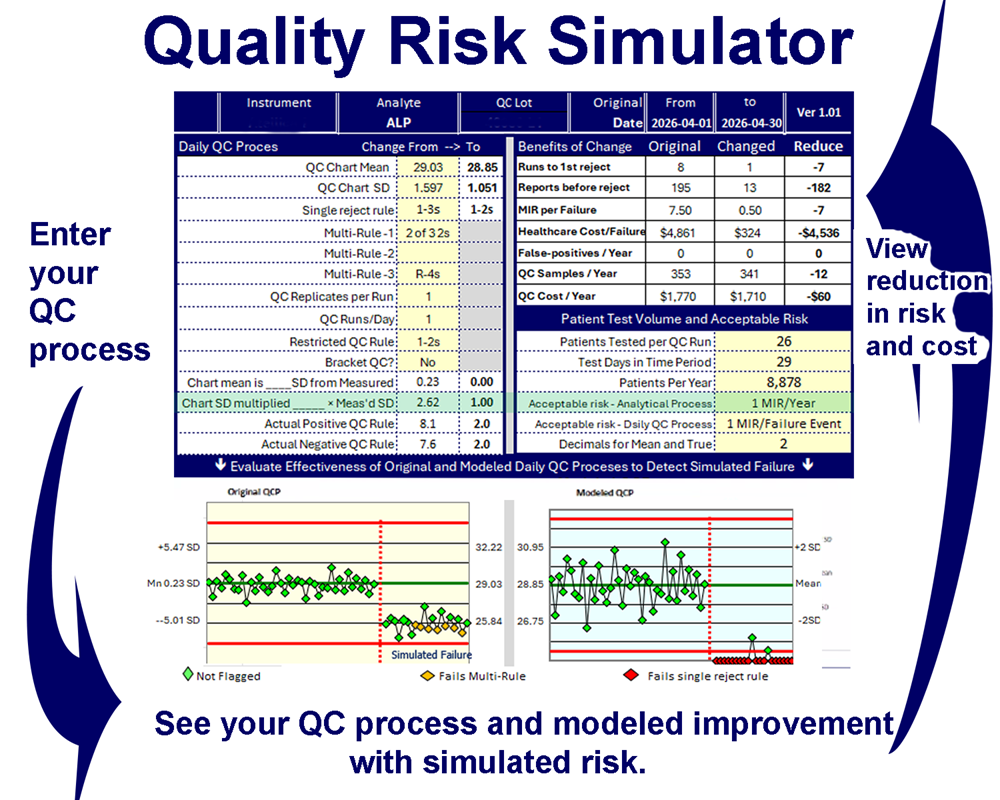
We’ll use an interactive risk simulator and case studies to explore:
- How risk changes even when Sigma does not.
- Why errors-per-million-results can be difficult to translate into operational meaning.
- How analytical performance can be expressed as the estimated frequency of medically incorrect results.
- Why “one error every 25 years” communicates something very different from “sigma = 4.25”.
- How risk information can help laboratories distinguish what deserves immediate attention from what does not.
Your Day 2 takeaway:
“I can look beyond the QC statistic and understand what the performance may mean in terms of patient risk.”
See the Difference for Yourself
What happens when the risk changes—but the Sigma doesn’t?
One medically incorrect result every 8 years
One every 8 months
One every 8 hours
Which one would you prioritize?
Explore the answer during Day 2 of the MasterClass.
Day 3 — OPERATIONALIZE
From Risk Intelligence to Better QC Decisions
Understanding risk is only useful if it helps you make better decisions.
What do you do with the information?
On Day 3, we’ll connect the concepts from the first two days to the practical laboratory workflow:

We’ll explore:
- How risk information can guide QC strategy.
- How to evaluate whether a QC process provides the protection it is intended to provide.
- How laboratories can prioritize quality effort where it matters most.
- How risk information can be communicated across different laboratory roles.
- How technology can make risk-based quality management more consistent and practical.
Then we’ll show you what this looks like when the process is operationalized.
Your Day 3 takeaway:
“I understand how risk information can become part of the way we make better QC decisions.”
What You Will Gain From the MasterClass
Practical knowledge you can take back to your laboratory
1. A clearer understanding of risk-based quality management
Understand how risk management fits alongside the QC practices your laboratory already uses.
2. A new way to interpret QC data
Learn how analytical performance can be translated into information about potential patient risk.
3. Better risk prioritization
Understand why not every quality event deserves the same level of attention—and how risk information can help identify priorities.
4. A more intuitive way to communicate risk
Move beyond technical statistical language when explaining the potential significance of analytical performance to colleagues and leadership.
5. A framework for better QC decisions
Connect risk assessment, risk quantification, QC strategy and monitoring into a more coherent quality-management process.
6. A practical look at operational risk intelligence
See how technology can support the risk-management process without requiring laboratories to abandon the QC workflows and knowledge they already have.
Who Should Attend?
Laboratory Professionals
Medical laboratory scientists, technologists, supervisors, and managers looking to master risk management
Quality Leaders
QA/QC coordinators, laboratory directors, and pathologists responsible for quality and patient safety
Forward-Thinking Leaders
Anyone seeking to implement value-based laboratory medicine and quantify ROI of quality improvements
You will get the most from this MasterClass if:
You already use statistical QC—and want to understand how risk-based thinking can make that QC more meaningful.
You are preparing for or strengthening ISO 15189 risk-management activities.
You are working with CLSI EP23 principles or developing risk-based QC plans.
You want to reduce time spent investigating low-risk QC events while improving visibility into meaningful analytical risk.
The Assumptions Behind Today’s QC Decisions
Recognize any of these?
The PT Fallacy
- “My proficiency testing is good, so quality is acceptable.”
The Detection Myth
- “I believe our current rules detect failure immediately.”
The Sigma Trap
- “QC rules and frequency can be based only on sigma.”
The SD Error
- “You should combine several reagent lots to establish method SD.”
The Global Perspective
Learn how ISO 15189:2022, CLSI/CLIA, and EFLM regulations are driving the shift toward Risk Management worldwide.
USA | Canada | Europe| India | Asia | Latin America | Africa
Join the Evolution of Quality Control
Extend proven QC science with real-time operational risk intelligence.
Upgrade your quality systems, reduce stress, improve patient safety, and lead the next generation of laboratory excellence.
Your Instructor and Moderator

Zoe Brooks
Co-Founder & CEO, AWEsome Numbers Inc
Building on decades of statistical QC science, Zoe developed the M.O.R.E. (Mathematically-OptimiZed Risk Evaluation) methodology to connect analytical variation with operational and patient-risk decision making.
Zoe is a globally recognized authority on laboratory risk management and quality control. Author of “Performance-Driven Quality Control” (AACC Press), multiple articles and scientific posters including the Award Winning “Impact of Seven Incremental Scenarios of QC Strategies. Her M.O.R.E. methodology powers AWEsome Numbers’ RiskGATOR software. (see more)

What happens next?
We’ll send you event details, access links, and information about your exclusive bonuses!